Tools and Techniques for Musicians, Composers, and Tinkerers
BootlegMic doesn't work...
16 posts · 31824 views
by kweks » Mon Aug 20, 2012 22:49 UTC
Hi.
It's summer and music-festival season, so thought I'd make a bootlegMic.
I grabbed the parts from my local electronics shop (Paris, France). They didn't have any 4 prong jacks, so I just used the cable from an old hands-free kit.
The build went fine, but when I try to make recordings with it (iPhone) - I get 'generated noise' - it goes:
Click-click-CLICK ... Click-click-CLICK ... Click-click-CLICK ... Click-click-CLICK ...
with little snatches of audio. It's perfectly timed and repetitive.
I've tested everything for continuity, it's all in order - no shorts, no shorts between components or cables.
There are only two things I can think of:
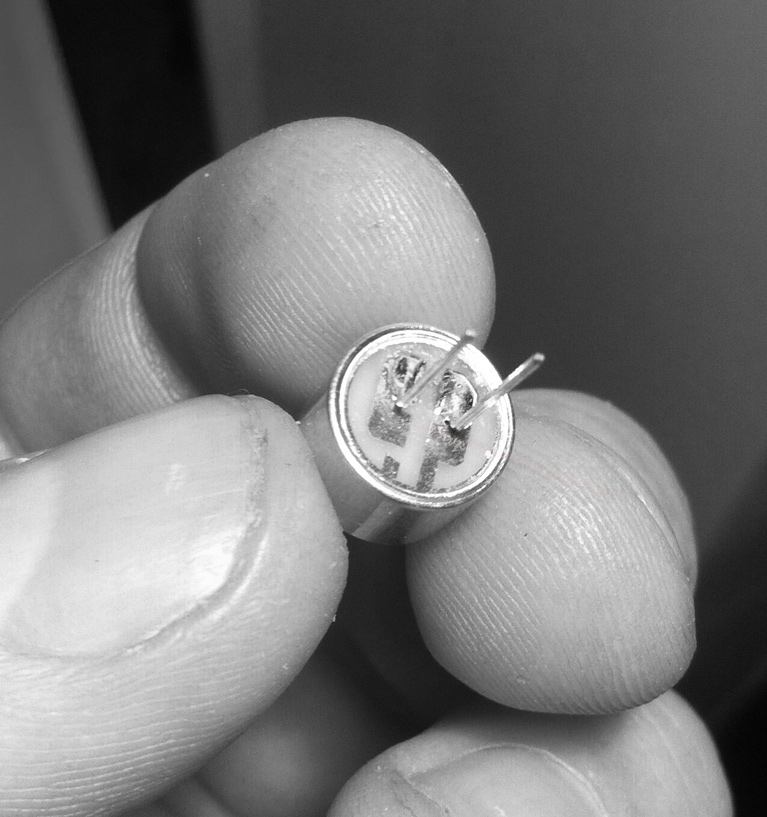
1: the microphone I have (see attachment) - has a slightly different layout - I cut on the right side, between the leg and the 'bottom' pad - as per the instructions.
2: perhaps I melted the microphone while soldering - but not sure how that would generate repetitive static.
The mic (untouched)
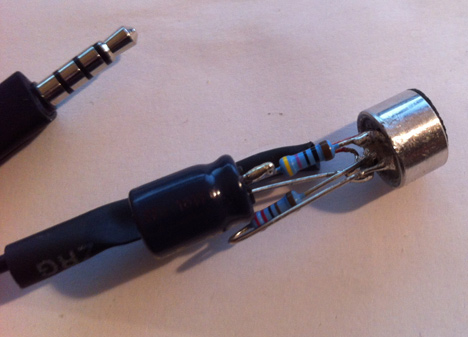
The mic (in situ)
The audio file:
http://www.ninjito.com/test.m4a
Any ideas? Thanks a bundle!
by guest » Tue Aug 21, 2012 04:02 UTC
the audio coming in and out is usually due to the iphone trying to detect whats attached. it pulls a little current through the circuit, and if its out of range, it assumes nothing is attached, and shuts off the mic in circuitry.
this current is fixed for a particular microphone. so it might be good to check that the microphone works with the circuit before putting the mods in. short out the 2.2k resistor, and disconnect the capacitor, and see what it does.
by kweks » Tue Aug 21, 2012 06:10 UTC
Thanks kindly.
OK - so, disconnecting the cap and shorting the resistor - the mic works perfectly w/ the iphone.
Re-connecting: clickity-click.
The only difference between the specs and what I have is that the cap is rated to 100V (they didn't have 10V on hand) - but that should be ok - ditto on the 1% tolerance resistors.
Most perplexing, any ideas where to go from here?
by guest » Tue Aug 21, 2012 14:22 UTC
try just putting the 2.2k resistor back in
and see if it works with that part
by kweks » Tue Aug 21, 2012 14:53 UTC
Hey - works without the capacitor.
Swapping the old one out for a new one, same thing - clickity-click.
Again, the only difference is that these caps are rated to 100V - seems odd that that could be it - but I guess it must be ?
by guest » Tue Aug 21, 2012 15:58 UTC
so here is what i think is happening:
when the iphone tries to detect what is attached, it puts a bit of current into the microphone. but, since the capacitor is there, all the current goes into the capacitor, and it gets a false reading. i was having some trouble exactly as you described when i was prototyping the bootlegmic. i was also using a long cable. perhaps the cable has something to do with it. perhaps try with a shorter cable. and if that doesnt work, try with a smaller capacitor, perhaps 10uF.
and give it a listen without the capacitor. the main function of that portion of the circuit is to reduce the volume a bit more. so maybe the volume is ok without it.
by kweks » Tue Aug 21, 2012 17:37 UTC
Hey - thanks kindly for your prompt replies.
Here's what I did:
Cut the cable right down - same deal (clickity-click)
Changed the cap for a 22uF, 50V - same deal (clickity-click)
Changed the cap for a 10uF 50V - same deal (clickity-click)
It seems that the inclusion of the cap is what is inducing the click click...
by guest » Tue Aug 21, 2012 18:10 UTC
are all the connections going to the right places
ground should be going to the second to last ring
and the microphone signal on the very last ring
and the capacitor/resistor combo goes from signal to ground
does unplugging it and then replugging it in quickly make any difference
i wonder if its possible to tell the iphone to not switch
are there any settings where it can be placed into external mic mode?
by kweks » Tue Aug 21, 2012 19:15 UTC
Hey -
Double checked everything from the ground up (From measuring the resistors to make sure they were the correct values) - desoldering everything and starting all over again.
Ground is 2nd last ring - and is bridged via the 2.2k resistor to the source pin.
Signal is last pin - and is bridged via the 470ohm + (now) 10uF 50V cap to ground.
There are no leaks. When I bridge the cap (leaving the 470ohm in place) - it works w/ the iphone.
Unplugging / plugging rapidly doesn't seem to make much of a difference.
Bridging the cap and then unbridging after recording has started results in the clickity click.
... :-/
by guest » Tue Aug 21, 2012 19:31 UTC
you can try recording with the 470ohm resistor in place and bridge the cap. the capacitor is just there to keep the voltage in the right range, but the microphone you have is different, so maybe it is not necessary.
another thing to try, is to put another resistor in parellel with the 470ohm/22uf combo. try 2.2k. the larger the better, but too large might not have the bypass effect we are looking for.
by kweks » Tue Aug 21, 2012 19:45 UTC
Second solution worked. The mic 'seems to be quiet' - much more so than when the cap is simply bridged.
Thank you very much - time to seal the puppy up in some heat-tube and see how it performs.
I will post a message back after a few tests..
by guest » Tue Aug 21, 2012 21:30 UTC
excellent!
definitey let us know how it goes, i think other people might want to homebrew their own as well.
by kweks » Mon Aug 27, 2012 08:42 UTC
Hey all.
Headed to the concert over the weekend. Big outdoor stage event.
Mixed results - I was fairly close to the stage (loud enough to need earplugs).
With that said - absolutely no distortion :)
The recording (no doubt somewhat mangled by compression) was definitely very soft, and lacks treble - presumably a resistor change could do the trick ?
by guest » Mon Aug 27, 2012 17:06 UTC
good to hear it didnt distort
the default iphone video recorder
has around 200hz to 16khz bandwidth
and there is a fair bit of compression
if it was too quiet
and you want to try making it louder
increase the value of the 470ohm resistor
try 680ohms
by kweks » Mon Aug 27, 2012 21:22 UTC
Thanks - I'll do that.
The volume wouldn't have had anything to do with the 2.2 across the cap ?
by guest » Tue Aug 28, 2012 16:35 UTC
yeah, that will reduce the volume as well
you can try bumping it up to 4.7k
as well as up the other one to 680ohms